Governance that fits how a group works
Role-based permissions let each location update its own hours, bios, and photos, while branding, navigation, and compliance stay with the central team.
We take the property over and improve it in phases. No big-bang rebuild.
Your whole group runs under one brand on one large WordPress site. It works, mostly, until it doesn't, and by now it's grown into something nobody on your team wants to touch. You don't need to start over. You need someone who runs WordPress at this scale to take it off your hands, put out the fires first, then make it better one phase at a time.
The same live website remains in place while disconnected, fragile parts become an ordered system under one accountable team.
One live propertyThe current site stays live through each phase
One accountable teamOne point of accountability for the property
Controlled phasesUrgent fixes before structural change
Every enterprise group already has a site, so the real work is running the one you have well. We inherit the property as it stands, become the single point of accountability for it, and fix what's urgent before we touch anything else.
You can stay on the platform you're on. A full replatform is on the table when the foundation genuinely can't carry where you're headed, but it's a call we make with you. It's never the opening move, and never one we force.
10 to 200+
locations can run on one WordPress property, under a single domain
We learn the property, secure the weak points, and move only as fast as the systems and search equity allow.
The current site stays live through every phase.
We inventory every system the site touches, including scheduling, CRM, location data, reputation, and analytics, plus the architecture under it and the search equity at stake. You get a clear picture of what's worth keeping and what's worth rebuilding.
We get access to every system, become the accountable party, and fix what's fragile first. Redirects, URL structures, metadata, and schema are validated before anything patients use changes.
Where the structure can't carry the next phase, we model locations, doctors, and service lines as structured data and rebuild the weak parts. Your current site stays live throughout.
The property moves onto our managed services and day-to-day support. Performance, accessibility, page quality, and conversion keep moving forward.
The pace is set by what's safe to migrate, not how fast pages can ship. We do much of the production work with our own tooling, which keeps the hours we need from your team low.
The visible site may stay familiar. Underneath it, the work becomes structured, documented, and predictable.
Inherited: Features were bolted on for years, and nobody is sure what breaks what.
Operated: Locations, doctors, and services live as structured data, with the relationships documented.
Inherited: Launching a campaign means a week of careful preparation.
Operated: Campaign pages ship on top of the structure without re-engineering it.
Inherited: Quality drifts from one location page to the next.
Operated: Every location page is built to the same standard by default.
Inherited: Every acquisition starts another round of surprise architecture work.
Operated: The next acquisition folds in as a records import.
Inherited: The integrations are a black box, so every change is a gamble.
Operated: Integrations are documented and monitored, so changes are predictable.
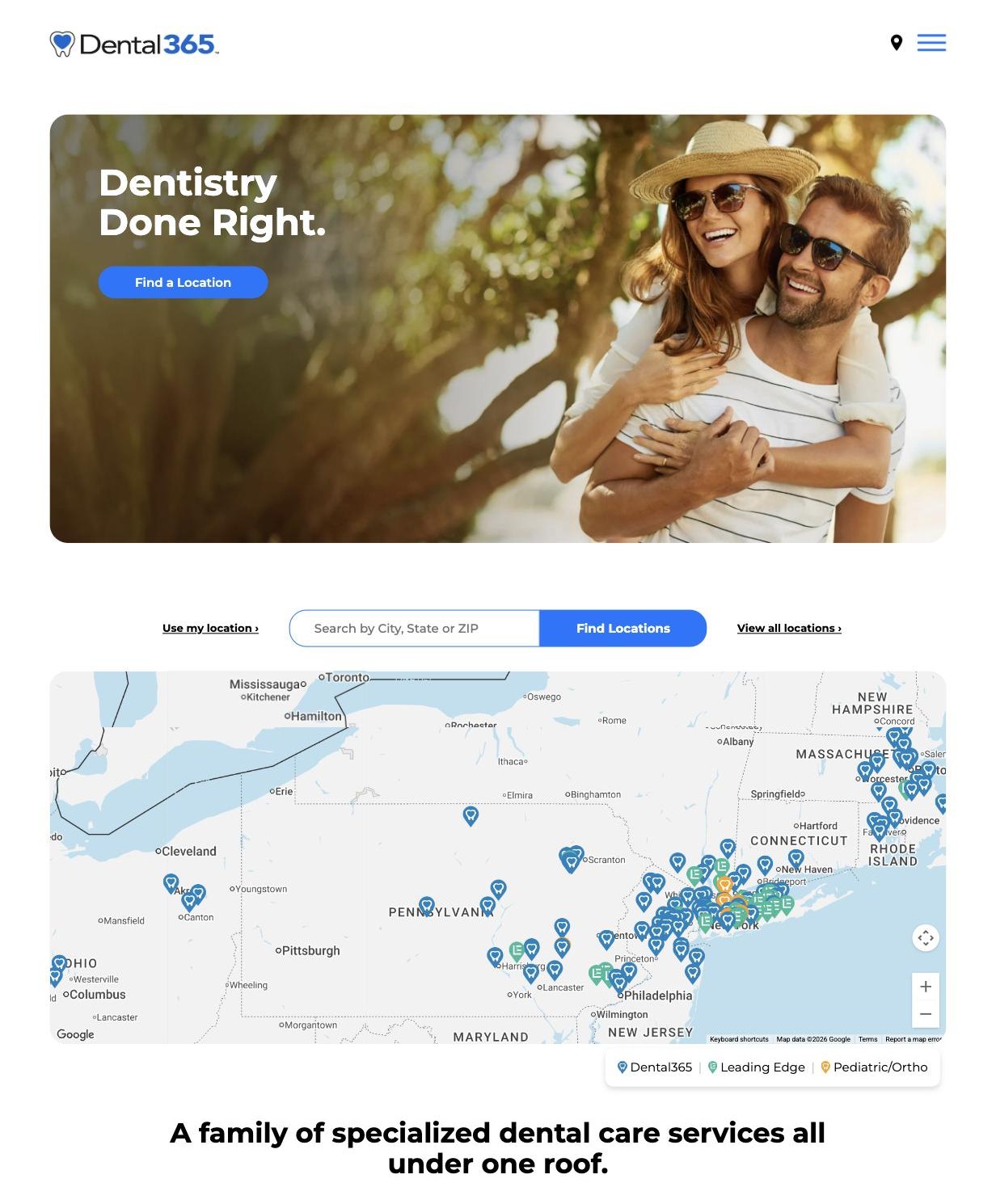
Premier Care Dental Management runs 130 practices under the GoDental365 brand on one enterprise WordPress property. Every location and doctor is a structured record, which keeps more than 200 location pages and the provider profiles consistent under one domain. Adding a practice is a records operation, not a fresh website build.
The systems around that structure are documented, and the marketing team can ship campaign pages on a steady cadence without re-engineering the property underneath.
About 20 yearsbuilding and running websites
500+ customersserved across healthcare
At one practice, a quality decision affects one site. At enterprise scale, it has to hold across hundreds of pages at once.
Role-based permissions let each location update its own hours, bios, and photos, while branding, navigation, and compliance stay with the central team.
Locations, doctors, and service lines are modeled as WordPress custom post types, so a new location folds in as a record instead of a fresh build.
Page types are built once and applied everywhere, so the next location page meets the same standard as the first.
Lean, vetted, monitored, and documented, so leads route correctly and nothing breaks quietly in the background.
PHI stays outside the website layer. Forms, scheduling, and patient portals route to HIPAA-compliant third-party systems. Accessibility work targets WCAG Level A as a baseline, with 2.2 AA available as scoped work, alongside CCPA and GDPR requirements.
There's a fair worry about running a large healthcare property on WordPress. Run carelessly, it gets slow and becomes a security liability. That's WordPress with an unvetted plugin stack and no patching discipline.
Run properly, with a lean plugin stack, structured content types, a hardened configuration, and proactive patching, it can carry hundreds of locations under one domain. You keep the openness and the deep WordPress talent pool without letting the property decay.
34%increase year over year
96%found in plugins
Source: Patchstack, State of WordPress Security 2024.
A takeover should remove uncertainty, not replace it with a new kind of lock-in. Here's what changes and what stays yours.
Yes. That's the whole premise. We get access, stabilize what's fragile, and improve from there. A rebuild is one possible phase, recommended only where the structure can't carry where you're headed. It's never the default.
Stabilization starts in the first weeks, and improvements ship steadily after that, so you're not waiting on a finished rebuild to see progress. Where a rebuild is warranted, it typically runs 4 to 6 months, in phases, with your current site live the whole time. You get a real timeline for your property on the first call, not a generic one.
It's open source, widely supported, and doesn't lock the property into a proprietary platform. Configured for scale, with structured content types, role-based permissions, and performance and security hardening, it can run hundreds of locations under one domain.
We build the migration around protecting search equity. Redirects and URL structures are preserved where they should be, metadata and schema are validated through the move, and rankings and indexation are monitored after launch so issues can be caught early.
Architecturally. PHI stays outside the website layer. Forms, scheduling, and patient portals connect to HIPAA-compliant third-party systems, and analytics use compliant tracking configured to scrub PHI. The site itself doesn't store PHI.
Less than most teams expect. The process uses a few structured check-ins for discovery, prototype reviews, and sign-offs through each phase. Local teams come in when their own content needs verification.
It's scoped per property because the number depends on the state of the site we inherit and how much rebuilding the phases call for. We walk the property and the systems it touches on the first call, and you get a real figure and a phased plan before anything is signed.
You take everything. The code, content, database, and domain are yours. Nothing proprietary runs underneath the property, so there's no platform penalty for moving it to another vendor. The move itself is the only cost.
Book a call and we'll walk through your current property, the systems it touches, and a phased path to take it over and make it better. No teardown required.